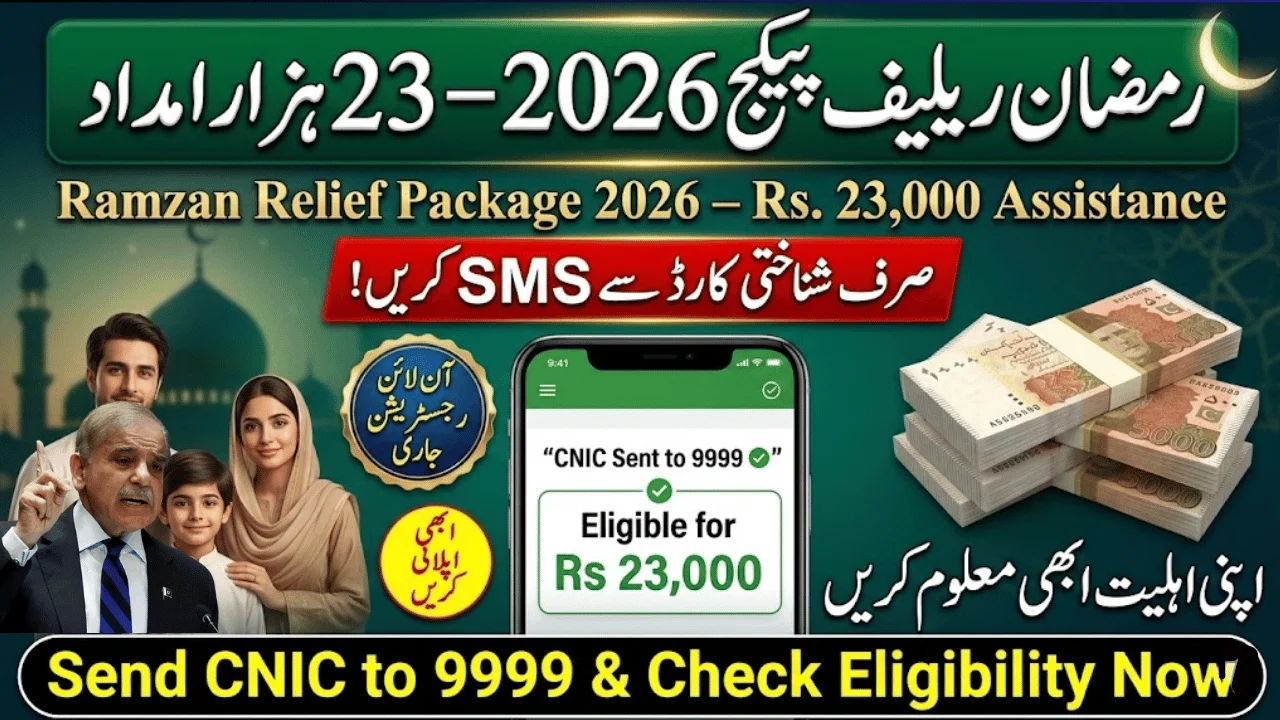
As Ramadan approaches, many families across Pakistan face the same difficult question: How will we manage rising grocery prices this month? With flour, sugar, ghee, and pulses costing significantly more than previous years, low-income households feel the pressure most.
To address this, the government has introduced the Ramzan Relief Package 2026, offering financial support of Rs. 23,000 to eligible families. Unlike older systems that required physical visits and paperwork, this time the process is largely digital — allowing citizens to apply using their CNIC through a simple SMS method.
Below is a complete, practical, and updated guide to help you understand eligibility, registration, payment methods, and how to avoid common mistakes.
What Is the Ramzan Relief Package 2026?
The Ramzan Relief Package 2026 is a targeted cash assistance initiative designed to help financially vulnerable households manage Ramadan expenses.
The program operates through welfare databases connected with:
-
Benazir Income Support Programme
-
Ehsaas Programme
-
National Database and Registration Authority
Instead of distributing ration bags in many areas, the 2026 approach emphasizes direct cash transfers, giving families flexibility to purchase what they actually need.
Why This Relief Package Is Important in 2026
Inflation in food commodities has remained volatile. Daily wage earners and informal workers are particularly affected during Ramadan when household food consumption increases.
This year’s program focuses on:
-
Faster eligibility checks through digital records
-
Reduced physical queues at offices
-
More transparent verification
-
Targeted assistance for already surveyed families
For many families, Rs. 23,000 can cover a major portion of Ramadan groceries.
Who Is Eligible?
Eligibility is primarily determined through the National Socio-Economic Registry (NSER) and income data verification.
Likely Eligible Groups
You may qualify if you belong to one of these categories:
-
Registered BISP beneficiaries
-
Families previously verified under Ehsaas surveys
-
Low-income households with limited assets
-
Widows without stable income
-
Daily wage earners
-
Unemployed individuals registered in welfare databases
Who May Not Qualify?
-
Government employees with stable salaries
-
Tax filers with high declared income
-
Individuals owning significant property or vehicles
-
Those with incomplete or invalid CNIC records
If you were previously declared ineligible, updating your household information through official channels may improve your chances.
How to Apply for Rs. 23,000 via SMS (Step-by-Step)
8070 آن لائن رجسٹریشن پورٹل – رمضان پیکیج 2026
The SMS registration process is designed to be simple and accessible.
Step 1: Open Your SMS App
Use your personal mobile phone. The SIM must be registered in your name.
Step 2: Type Your CNIC
Enter your 13-digit CNIC number without dashes.
Example: 3520212345678
Step 3: Send to the Official Code
Send your CNIC to 9999 (as officially announced for the Ramzan Package 2026).
Step 4: Wait for Confirmation
You will receive an automated response informing you whether:
-
You are eligible
-
Your data is under verification
-
You are currently ineligible
Do not resend multiple messages repeatedly. It does not improve approval chances.
How Eligibility Is Verified
The verification process is automated and cross-checks:
-
CNIC validity via NADRA
-
Household income records
-
NSER poverty score
-
Previous welfare program registration
In some cases, biometric verification may be required before payment collection.
How Will Payments Be Distributed?
Once approved, beneficiaries may receive funds through:
-
BISP-designated payment centers
-
Partner banks
-
Mobile wallet services
-
Special Ramadan relief camps
Biometric thumb verification may be required for secure collection.
Common Mistakes to Avoid
Many deserving applicants get delayed due to small errors. Avoid these:
❌ Sending CNIC from someone else’s SIM
❌ Using an expired CNIC
❌ Trusting agents demanding registration fees
❌ Sharing personal data on unofficial websites
❌ Ignoring verification SMS messages
Registration is free. No agent is required.
Practical Example
Consider a daily wage worker in Lahore earning irregular income. During Ramadan, food expenses increase by nearly 30%. If approved for Rs. 23,000:
-
Flour and rice for the month can be covered
-
Cooking oil and sugar expenses are managed
-
Some amount remains for electricity bills or school expenses
The flexibility of cash assistance makes it more practical than fixed ration packages.
Pros and Cons of the 2026 Ramzan Package
| Pros | Cons |
|---|---|
| Simple SMS registration | Database errors may cause ineligibility |
| Direct cash transfer | Delays possible during high demand |
| No physical forms required | Not all deserving families are in NSER |
| Transparent digital verification | Requires CNIC-linked SIM |
2026 Updates You Should Know
-
Greater integration with digital databases
-
Faster automated eligibility responses
-
Increased monitoring to prevent fraud
-
Stronger biometric verification mechanisms
The government has improved fraud detection systems compared to previous years.
Frequently Asked Questions (FAQs)
1. Can I apply if I am not part of BISP?
Yes, but your eligibility depends on your poverty score and NSER data. Being in BISP increases approval chances.
2. What if I don’t receive a reply after sending SMS?
Wait at least 24 hours. Network congestion during Ramadan may cause delays.
3. Can I apply using someone else’s phone?
It is strongly recommended to use a SIM registered under your own CNIC.
4. Is there any registration fee?
No. The application process is completely free.
5. What if I am declared ineligible?
You may update your household information through official welfare channels for future assistance programs.
6. When will payments start?
Disbursement typically begins before or during the first week of Ramadan, subject to approval timelines.
Final Thoughts
The Ramzan Relief Package 2026 is a critical support initiative for low-income families facing rising food costs. The simplified SMS registration system makes access easier than before, but eligibility depends heavily on accurate and updated records.
If you believe you qualify, apply early, use only official channels, and ensure your CNIC and SIM details are correct. A small step today could provide meaningful financial relief during Ramadan.
If you need updates about government schemes and verification processes, staying informed through trusted sources is essential — especially during high-demand periods like Ramadan.